
Why Scent Is Still Hard to Exhibit, and What Recently Changed
Smell is the hardest sense to put in a museum, and the reasons have not changed: it will not stay where you put it, visitors cannot look away from it, and nobody can re-enter an exhibition and smell the same thing twice. What has changed in recent years is the ambition, not the physics. Museums have stopped treating scent as a novelty and started treating it as a narrative device with its own delivery discipline, which is a real improvement and a much harder job.
Key takeaways
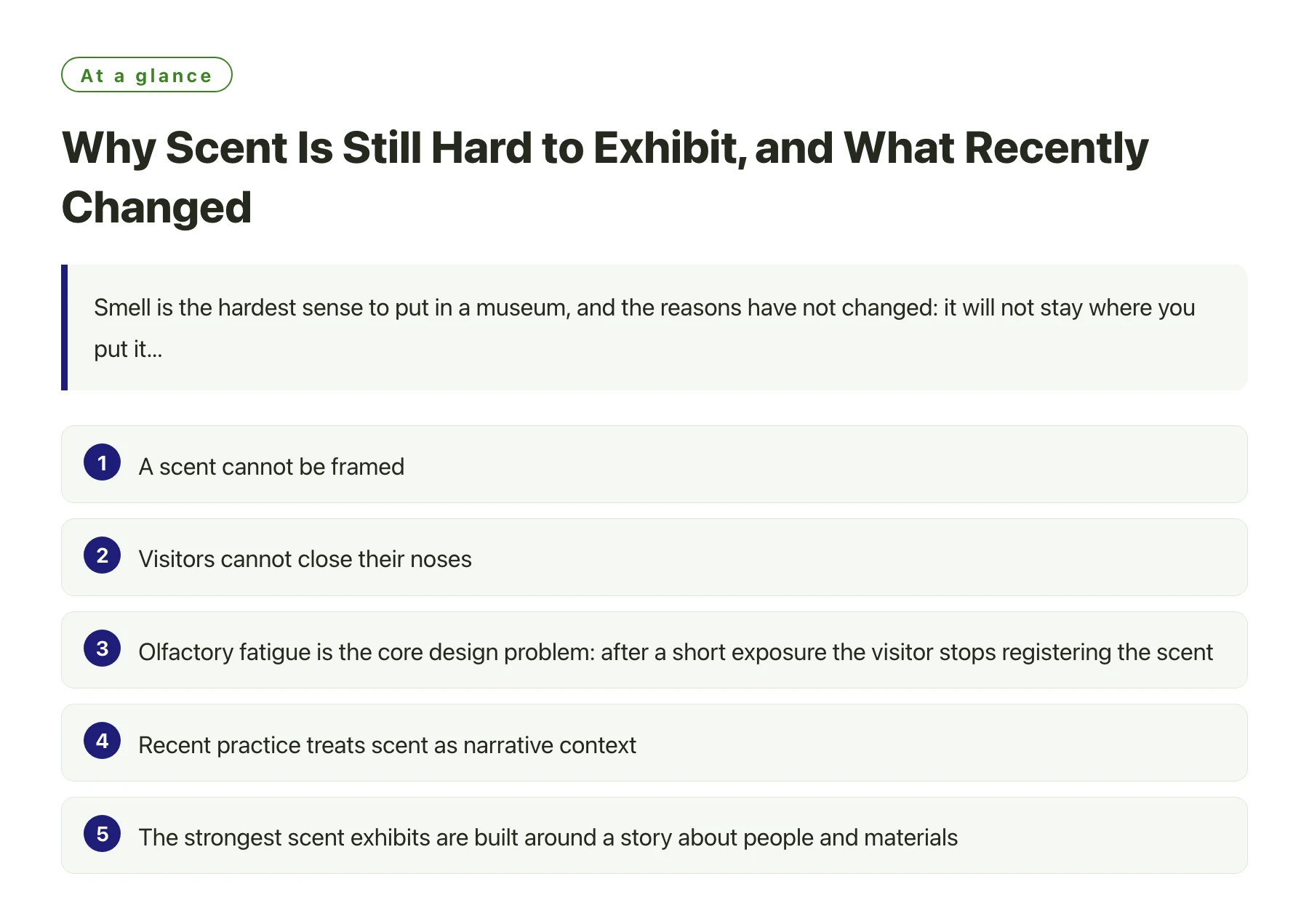
- A scent cannot be framed, so an olfactory exhibit has to control where the smell is at any given second rather than where the object is.
- Visitors cannot close their noses, which means an exhibit has to plan for people who do not want to participate.
- Olfactory fatigue is the core design problem: after a short exposure the visitor stops registering the scent, so the exhibit must sequence and rest noses deliberately.
- Recent practice treats scent as narrative context, used at chosen moments, rather than as an object presented continuously.
- The strongest scent exhibits are built around a story about people and materials, which is why cultural and material heritage collections suit the format so well.
Every olfactory exhibition runs into the same four walls. The first is containment: light stays in a case, sound can be channelled through a speaker, but a smell spreads. The second is attention: a visitor can choose not to look at something, but not to breathe. The third is memory: noses adapt within minutes, so the second half of a gallery is experienced by a nose that is already tired. The fourth is repeatability, because the same room can smell different on a busy afternoon and a quiet morning.
Those constraints are why scent exhibits took so long to be taken seriously, and why the ones that work are designed by people who treat smell as an environmental condition rather than as an object on a plinth.
The four problems that keep coming back
Containment is the first. Scent has no edges, so a gallery either accepts that smells bleed between zones or invests in controlled delivery, extraction and air handling. Both are valid, but they produce very different exhibitions, and a designer who ignores the choice will have it made for them by the building's ventilation.
Attention is the second, and it is more social than technical. Some visitors arrive wanting to smell everything, others arrive worried about headaches, allergies or simply being surprised. A scent exhibit that does not offer a way to opt out quietly is a scent exhibit that generates complaints, and complaints are what turn a museum board against the format.
Fatigue is the third and the most underrated. A visitor's ability to detect a smell declines quickly with continued exposure, so a sequence of six intense scents in one room is not six experiences, it is one experience followed by five diminishing ones. Spacing, rest intervals between stations and lower intensities do more for an exhibit than a stronger diffuser.
Conservation is the fourth, and it has no solution
Objects can be conserved; a smell cannot. What can be conserved is the knowledge of how it was made, which is why olfactory exhibitions increasingly document materials and methods rather than attempting to freeze an aroma. That framing also fits the way museums already describe intangible heritage: practices and knowledge rather than physical things [1].
This shift matters commercially as well as curatorially. Once a scent is presented as knowledge, the exhibit can be honest about the fact that the visitor is smelling a reconstruction, and the reconstruction itself becomes the subject.
What has actually changed in recent years
The first change is delivery. Timed pulsing, dedicated scent stations and hands-on blotters have replaced the single diffuser filling a whole room. The equipment is not exotic, but treating scent as something to be dosed rather than released has improved the experience more than any new technology.
The second change is curatorial. Scent has moved from a side attraction into the narrative structure of exhibitions about trade, materials, food, ritual and daily life. Where a display case can show what an object looked like, a scent station can carry what a place smelled like, and museums have become more confident about using it that way.
The third change is professional. Museum practice has spent the last two decades broadening what counts as a collection and how visitors are involved, and scent has benefited from that opening [2]. The vocabulary that used to belong to perfumery, such as dosage and resting, is now part of exhibition design conversations.
Why a scent museum is a different building from a room with diffusers
A building dedicated to scent has to solve containment, fatigue and repeatability at once, which is an architectural problem before it is a curatorial one. Zones have to be separated by air handling, not by walls alone. The route through the building has to pace the nose. Materials have to be stored and presented in a way that keeps them stable through a full day of visitors.
That is the difference between a temporary olfactory installation and a permanent institution. Xuelei operates a scent museum in Guangzhou that the company describes as the world's largest fragrance museum, and the interesting part for anyone planning a scent experience is not the scale but the fact that the format has to work on a Tuesday morning as well as at a launch event.
Professional bodies that represent museums spend a good deal of effort on precisely this kind of question, including how institutions evaluate new formats and what evidence they collect before committing to them [3]. For a brand considering its own scent experience, that is a useful discipline to borrow: decide what the experience is for, how visitors will move through it, and how it will be refreshed, before choosing any hardware.
What the materials themselves bring
Scent exhibits that work are usually built on a material story rather than on an abstract mood. A gallery about a region's perfumery has something to show when it can point to the plants, the extracts and the trade routes behind them, which is why collections rooted in specific ingredients read more clearly than those built from generic accords Chinese perfume ingredients.
It also gives visitors an entry point that does not depend on liking the smell. Even someone who finds a particular note unpleasant can follow what it is, where it comes from and why it mattered, which turns a subjective reaction into a piece of learning. That is the move that makes an olfactory exhibit survive the novelty phase.
The company behind such a collection is not usually a perfumery alone. Xuelei is a fragrance and home fragrance manufacturer that also runs the museum, and the combination is not accidental: knowing how a material behaves in production is a large part of knowing how to present it in a room the company behind the fragrance museum.
If you are planning a scent experience of your own, borrow one habit from museum practice: prototype the route before the room. Walk the sequence, time the intervals and test the nose fatigue at station five. Most failures in retail and hospitality scenting are routing failures wearing a technical costume.
Sources
- UNESCO Intangible Cultural Heritage —— UNESCO's programme and lists for intangible cultural heritage, covering traditional knowledge and craftsmanship.
- ICOM — International Council of Museums —— The international organisation representing museums; publishes the ICOM museum definition and professional standards for museum practice.
- Museums Association —— A professional body for museums, publishing guidance and research on museum practice and visitor experience.
Frequently asked questions
Why can a visitor not simply smell one exhibit for a long time?
Because of olfactory adaptation. Continued exposure to the same smell reduces the ability to detect it, usually within minutes, so long dwell times reduce rather than increase what a visitor experiences.
Do scent exhibits need special ventilation?
They need controlled air movement and extraction, otherwise smells migrate between zones and the exhibition becomes one blended atmosphere. The building's air handling is often the deciding factor in what can be designed.
Is an olfactory exhibition suitable for all visitors?
No, and good ones plan for that with clear opt-out routes, warnings and low-intensity alternatives. Fragrance sensitivity is common, and an exhibit that ignores it will not stay open long.
What makes a scent exhibit feel dated?
A single diffuser for an entire space, a continuous smell with no sequence, and no explanation of what the visitor is smelling. Scent without narrative reads as ambience, and ambience is forgettable.
Can a brand build a scent experience without museum expertise?
It can, but it should hire for the part it lacks. The common failure is a beautiful space with an off-the-shelf diffuser and no plan for pacing, maintenance or refresh, which visitors read within thirty seconds.
You've read the take. Now argue it.
1.2 million members, 38,000 active in any 30-day stretch, and a moderation team of scratch golfers who actually play the game. Register once, post forever.
Join the Conversation →